STAT-ON® in Real-World Clinical Practice: Insights from the MoMoPa-EC Trial
1. Introduction
Parkinson’s disease (PD) is a complex and fluctuating condition. Patients experience alternating periods of good motor function (“ON” time) and impaired mobility (“OFF” time). Monitoring these fluctuations is critical for optimizing treatment, yet traditional approaches rely heavily on subjective patient reporting.
Wearable medical devices like STAT-ON® offer a solution: objective, continuous, and user-friendly monitoring in real-life conditions.
2. About the MoMoPa-EC Study
MoMoPa-EC was a multicenter, cluster-randomized, clinical trial involving 156 patients with advanced Parkinson’s disease and difficult-to-control motor fluctuations. Conducted across 35 hospitals in Spain, the study compared three approaches to inform treatment adjustments:
- Clinical visits alone (control group)
- Clinical visits + patient-reported Hauser diary
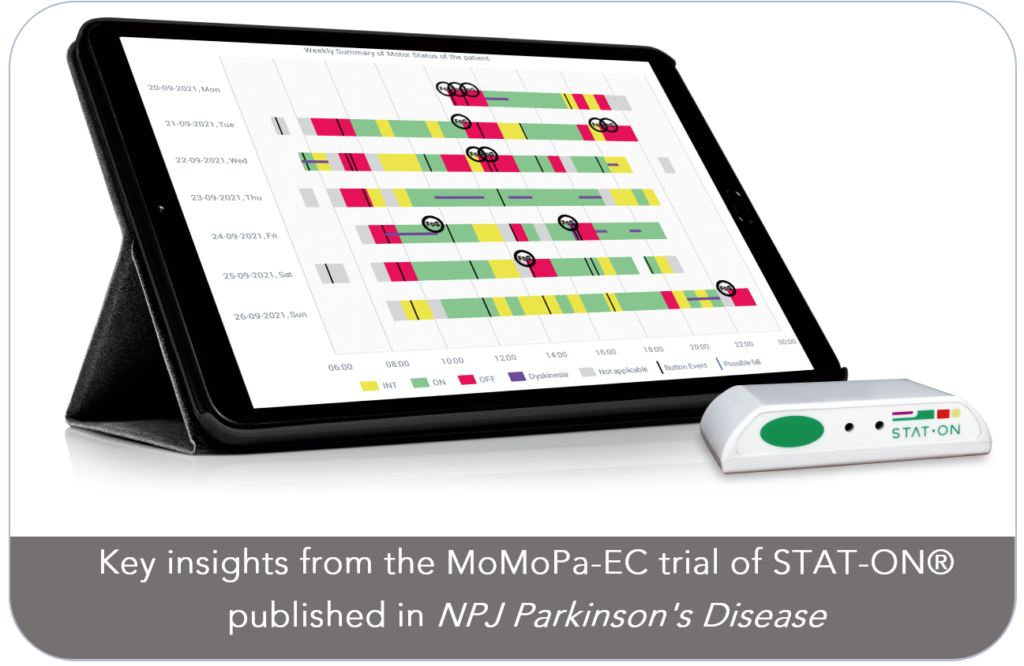
- Clinical visits + STAT-ON® wearable sensor
The primary goal: to determine whether using STAT-ON® data improves clinical outcomes, specifically by reducing daily “OFF” time.
3. Key Findings
The study found no statistically significant difference in clinical outcomes—such as OFF time, ON time, dyskinesia, or quality of life—between the three groups.
While this could be seen as disappointing, the study actually provides critical insights into how digital health tools are used (or not used) in real-world clinical practice.
Actually, this is the first time that a wearable device is evaluated under real conditions in a clinical trial.
4. What Does the Study Tell Us About STAT-ON®?
- STAT-ON® was successfully deployed across 35 hospitals and used by 38 neurologists with no technical issues or dropouts—demonstrating feasibility and real-world usability.
- It produced comparable results to gold-standard methods (like the Hauser diary, UPDRS), but with the added benefit of being objective, continuous, and passive for the patient.
- It was well accepted by clinicians and patients alike, and generated actionable motor data over several days—something traditional tools cannot easily achieve.
5. Understanding the Clinical Impact of STAT-ON®?
The paper might be seen as negative for the use of STAT-ON, but there are several reasons—none related to the quality of the device itself:
- Limited time in Consultation:Neurologists use to prioritize patients’ verbal reports and their own clinical observations over objective data.
- Limited integration of objective data: Clinicians may not have been trained or had time to fully interpret and apply STAT-ON® data during consultations.
- Therapeutic caution: About 25% of patients didn’t receive any medication changes. Neurologists may have opted for stability over adjustments, especially when faced with complex cases.
- Multifactorial decision-making: Clinical decisions in Parkinson’s are based not only on motor fluctuations, but also on non-motor symptoms, quality of life, comorbidities, and patient preferences.
- Skepticism on new technology: This was the first time several doctors receive STAT-ON’s information, however, still many relied on patient’s explanation.
In short, STAT-ON® worked as expected—but the healthcare system wasn’t ready to fully use the insights it provided. Moreover, many clinicians were not yet willing or prepared to incorporate its insights into decision-making. This reflects a broader resistance to change in clinical routines and underlines the urgent need for education, engagement, and cultural shifts within the neurology community.
6. The Value of STAT-ON®
STAT-ON has shown very good results in external validation, being feasible to be used in clinical practice [1], selecting patients for second-line therapies [2], detecting accurately FoG and Dyskinesia [3], or in a cost-benefit analyses [4], [5], among other clinical validations [6].
In this clinical trial, STAT-ON® was compared against diaries using UPDRS as reference, showing superiority (0.67 vs 0.24) [7]. Moreover, STAT-ON showed alignment with UPDRS sub-scales, FoG-Q, and PDQ-39, showing the high performance of the device in real settings[8].
STAT-ON® brings enormous value to Parkinson’s care:
- Scientifically validated algorithms backed by peer-reviewed studies
- High patient adherence and zero data-entry burden
- Day-to-day motor profiling with no user input
- Ideal for remote monitoring and personalized care models
The MoMoPa-EC study highlights the need to evolve clinical workflows so that objective data can be fully leveraged. Wearable devices like STAT-ON® are not just tools—they are enablers of a new, more responsive model of care.
This study has also highlighted the persistent skepticism and apprehension among neurologists regarding the adoption of new technologies. There is a clear need for targeted education in this area, led by experienced professionals. International organizations such as the MDS, Parkinson’s Europe, the European Academy of Neurology, and NICE, among others, should take a proactive role in developing structured plans to integrate these valuable tools into routine clinical workflows for the benefit of patients.
7. Conclusion
MoMoPa-EC did not question the performance of STAT-ON®. Instead, it revealed that technology alone is not enough. The real challenge lies in integrating objective data into everyday medical decision-making.
STAT-ON® is ready. Now it’s time for healthcare systems to adapt—and unlock the full potential of digital monitoring in Parkinson’s disease.
[1] N. Caballol, À. Bayés, A. Prats, M. Martín-Baranera, and P. Quispe, “Feasibility of a wearable inertial sensor to assess motor complications and treatment in Parkinson’s disease,” PLoS One, vol. 18, no. 2, p. e0279910, Feb. 2023.
[2] I. Cabo-Lopez, A. Puy-Nuñez, N. Redondo-Rafales, S. Teixeira Baltazar, and B. Calderón-Cruz, “Holter STAT-ONTM against other tools for detecting MF in advanced Parkinson’s disease: an observational study,” Front Neurol, vol. 14, Aug. 2023.
[3] A. Zampogna et al., “Unveiling the Unpredictable in Parkinson’s Disease: Sensor-Based Monitoring of Dyskinesias and Freezing of Gait in Daily Life,” Bioengineering, vol. 11, no. 5, p. 440, Apr. 2024.
[4] E. Cubo et al., “Cost‐utility analysis of a coadjutant telemedicine intervention for fall prevention in Parkinson’s disease,” Eur J Neurol, vol. 32, no. 1, Jan. 2025.
[5] R. Del Pino et al., “Virtual coach and telerehabilitation for Parkinson´s disease patients: vCare system,” J Public Health (Bangkok), Nov. 2023.
[6] D. Rodríguez-Martín et al., “A New Paradigm in Parkinson’s Disease Evaluation With Wearable Medical Devices: A Review of STAT-ONTM,” Front Neurol, vol. 13, Jun. 2022.
[7] C. Pérez-López et al., “Comparison of the Results of a Parkinson’s Holter Monitor With Patient Diaries, in Real Conditions of Use: A Sub-analysis of the MoMoPa-EC Clinical Trial,” Front Neurol, vol. 13, May 2022.
[8] C. Pérez-López et al., “Comparison of clinical measures of motor function with a Holter monitor in Parkinson’s disease,” Clin Park Relat Disord, vol. 12, p. 100325, 2025.